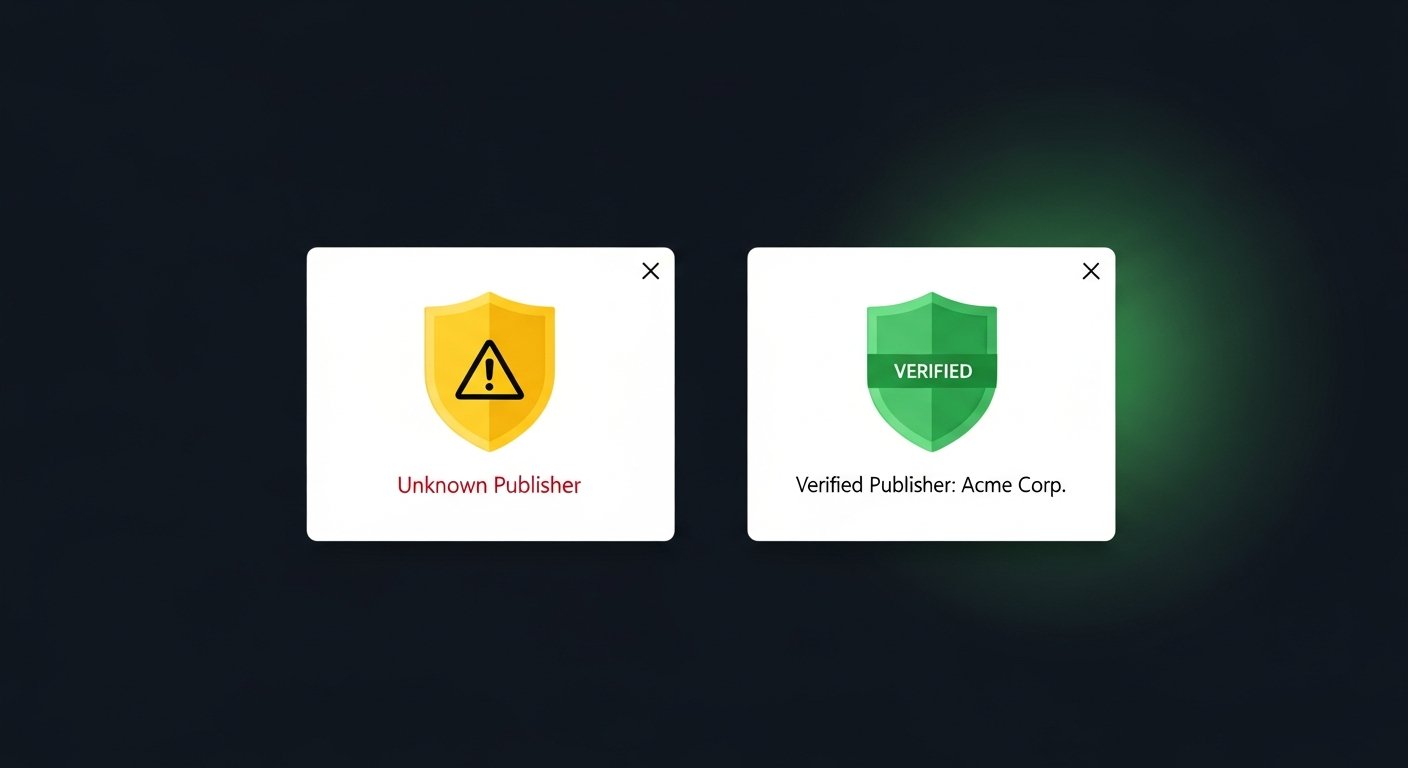
The real decision when buying a code signing certificate is OV or EV. Both sign your software, and both aim to remove the "unknown publisher" warning. But one does it right away, and the other takes time. If you're starting from scratch, see what a code signing certificate is first.
What They Share: Most of It
The comparison starts by clearing away everything that isn't different:
- Signature strength is identical — both use the same cryptographic algorithms. EV does not mean "stronger encryption."
- A hardware token is required for both — the private key lives on a token or in an HSM. That now applies to OV too.
- Both show your company name — your verified organization name appears in the signature.
The Real Difference: SmartScreen Reputation
When a program is downloaded on Windows, Microsoft SmartScreen steps in and asks: "do I recognize this publisher?" This is exactly where OV and EV part ways.
With OV, your signature is valid, but SmartScreen doesn't know you yet. Reputation builds over time, as your software is downloaded enough times and runs without issues. During that stretch, your users may see an extra warning screen.
With EV, SmartScreen reputation is there from the start. The first user, on the first download, sees no warning.
OV vs EV: The Comparison Table
| Criterion | OV Code Signing | EV Code Signing |
|---|---|---|
| Signature strength | Full | Full (same) |
| SmartScreen reputation | Builds over time | Immediate |
| Validation | Business identity | Most thorough corporate vetting |
| Hardware token | Required | Required |
| Issuance time | Shorter | Longer (deeper review) |
| Relative cost | Lower | Higher |
| Best for | Internal use, known software, budget-conscious | New launches, wide audiences, consumer software |
Which Should You Pick?
- Pick EV if you're launching new software, distributing to a wide audience, or can't accept a warning on the first download.
- Pick OV if your software goes to a narrow, known audience, you're distributing internally, or you can wait for reputation to build.
If you're wondering about the warning screen your users actually see and how it goes away, our article on the "Unknown Publisher" warning covers exactly that.
With OV you earn trust; with EV you start with it.