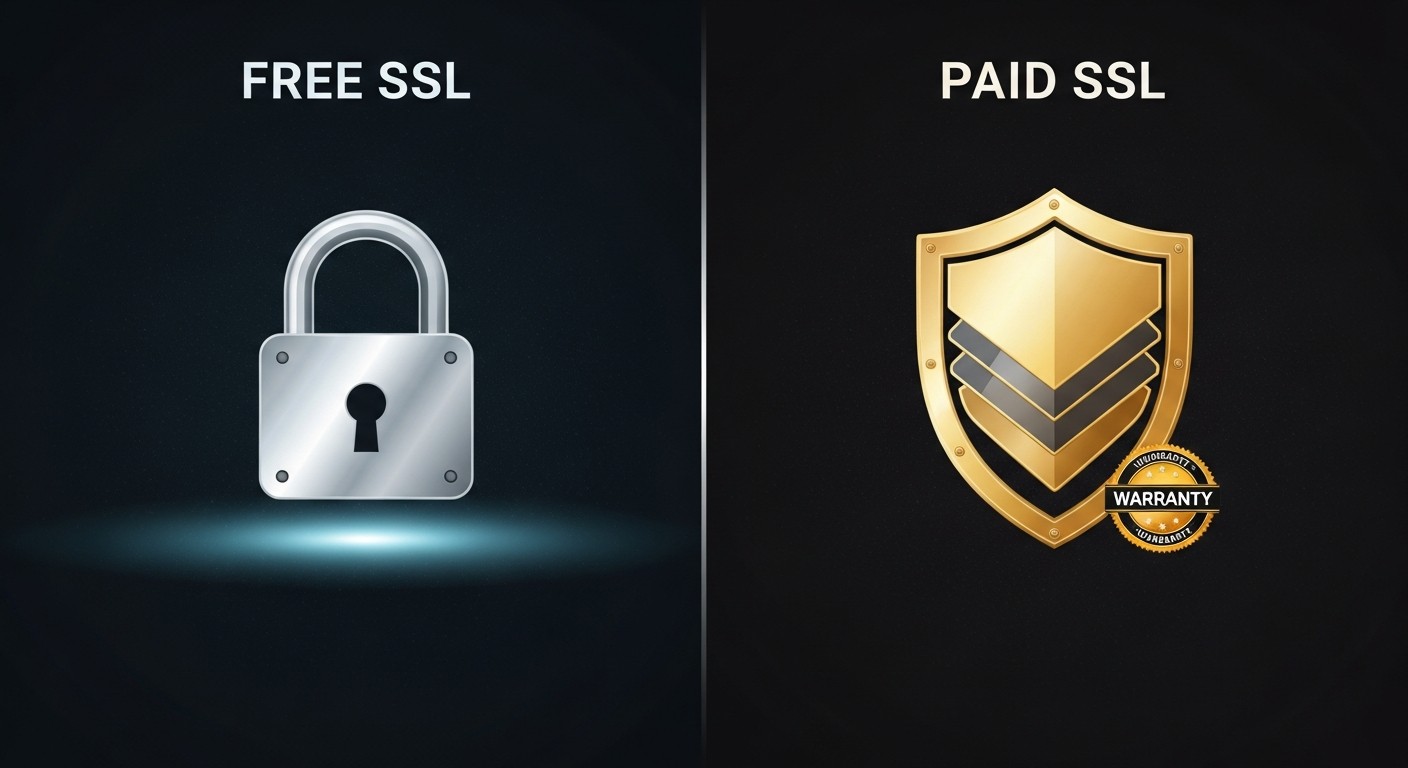
Running a website today takes more than good content or a clean design. Google and modern browsers now treat HTTPS as the baseline, and sites without it get flagged "Not Secure" right in the address bar. SSL has become a requirement, not a nice-to-have.
The real question is narrower: is free SSL enough for your business? Here's a clear look at what free SSL delivers, where it stops, and which side of the line your project sits on.
What Free SSL Is and How It Works
Free SSL certificates are usually Domain Validation (DV) certificates issued by trusted authorities such as Let's Encrypt. What they do is straightforward:
- 🔐 Encrypt the data moving between a visitor's browser and your server.
- 🌐 Turn on HTTPS so the connection is secure.
- ⚠️ Remove the "Not Secure" warning browsers show on plain HTTP.
These certificates are free and renew automatically. For personal blogs, simple landing pages, and small portfolio projects, that's usually the only SSL you need.
The Advantages of Free SSL
Free SSL became the default for good reasons:
- Completely free — no license fee, no renewal bill.
- Fast, simple setup — most hosts activate it with a single click.
- Baseline trust — HTTPS encryption and the end of the "Not Secure" label.
- SEO benefit — Google counts HTTPS as a ranking signal, and a free certificate satisfies it.
The Limits of Free SSL
The limits of free SSL aren't technical — they're informational. Here's what to know before you rely on it:
- DV validation only — it confirms domain ownership but says nothing about the company behind the site.
- No warranty or insurance — paid SSL carries $10,000 to $1,750,000 in coverage; free SSL carries none.
- Not a fit for e-commerce or corporate sites — without organization validation, the trust signal is weaker.
- No professional support — when something breaks, you troubleshoot it alone.
Who Free SSL Is Right For
Free SSL is genuinely the correct choice for a wide range of sites. If your project fits any of these, don't overthink it:
- Personal blogs
- Small hobby and informational sites
- Simple portfolio pages
- Non-commercial promotional sites
If your visitors aren't entering payment details, sensitive personal data, or business credentials, free SSL covers your encryption needs without compromise.
Who Should Skip Free SSL
The list is short and predictable, but the cost of getting it wrong is high:
- E-commerce sites
- Platforms handling payments, memberships, or financial transactions
- Corporate and professional company websites
- Applications that collect sensitive user data
Any project that depends on a trust relationship needs more than free SSL alone.
A Quick Self-Check
Run your site through these questions. If you answer "yes" to any of them, free SSL is probably not enough on its own:
- Do visitors enter payment or card details on your site?
- Do people log in, or do you store personal or account data?
- Are you a registered business that benefits from looking verifiably legitimate?
- Would a "this site can't be trusted" impression cost you a sale or a client?
If all four are "no," you're in free-SSL territory. If even one is "yes," the value of verified identity starts to outweigh the cost of a certificate.
When Free SSL Is Genuinely Enough
Plenty of sites never need anything more than free SSL. Don't overthink it if yours is one of these:
- Personal blogs and writing sites
- Portfolios and résumé pages
- Small informational or hobby sites
- Non-commercial projects that collect no sensitive data
If visitors aren't handing over money or private information, free SSL meets your encryption needs cleanly. Paying for more would buy trust signals you don't actually have a use for.
When Free SSL Isn't Enough
The list of cases where free falls short is short and predictable — but the cost of getting it wrong is real:
- Online stores and any site with a checkout
- Platforms handling payments, subscriptions, or memberships
- Corporate and professional sites where the brand has to look credible
- Apps that collect health, financial, or otherwise sensitive data
In those cases, an OV certificate (organization-validated) or an EV certificate (extended validation, the strictest vetting) puts a verified identity inside the certificate. Combined with the warranty and direct CA support, that's what closes the gap free SSL leaves open.
How Google Sees Free SSL
For Google, what matters is whether HTTPS is enabled — not whether the certificate was free or paid. On the SEO side, free SSL is enough.
Trust and conversion are a different story. On e-commerce sites especially, OV and EV certificates tell the visitor: this company is real, verified, and trustworthy. That confidence shows up in behavior:
- ⏱️ Longer time on site
- 📉 Lower bounce rates
- 🛍️ Higher purchase rates
Google watches those behaviors too, and they feed back into rankings.
The Core Differences Between Free and Paid SSL
Strip away the marketing and the jargon, and the differences come down to six dimensions:
| What it covers | Free SSL | Paid SSL |
|---|---|---|
| Validation level | DV only | DV, OV, or EV |
| Warranty | None | $10,000 – $1,750,000 |
| Organization verification | None | Yes (OV/EV) |
| Technical support | Community forums | Direct CA support |
| Trust perception | Low — padlock only | High — verified identity visible |
| Recommended use | Personal and informational sites | Commercial, corporate, regulated |
Free SSL Isn't Enough for Every Project
Free SSL secures the basics and installs fast, which makes it ideal for simple sites. But when user data is critical, brand reputation is on the line, or a project needs to look professional, a paid certificate with stronger validation is the right choice.
In short:
- ✅ Every website should use HTTPS
- ⚖️ Free SSL isn't enough for every project
- 🏢 Corporate projects need paid SSL
- ⭐ Trust = conversion + reputation